:format(webp))
:format(webp))
Modernizing Your App: Angular-to-React Migration in 2025
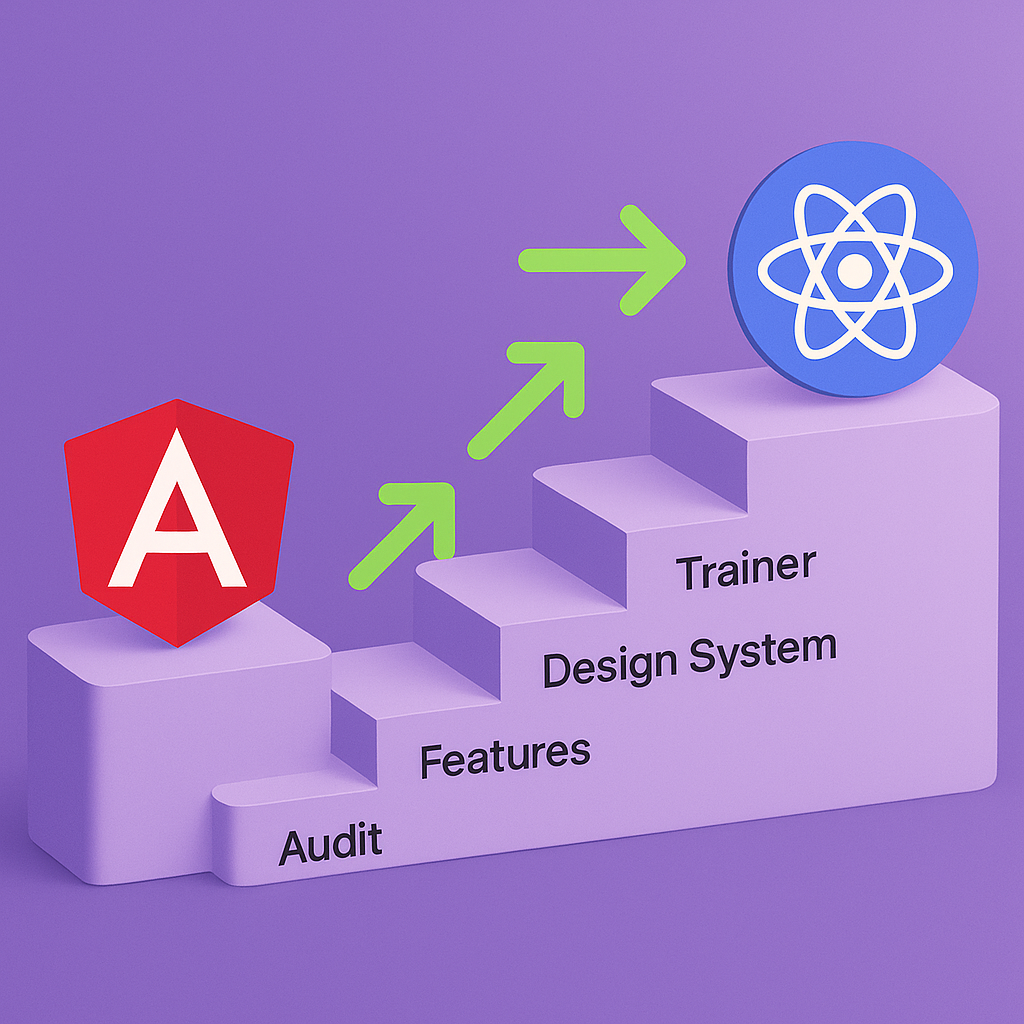
Moving a mature Angular application to React can feel daunting. By reading this guide, you’ll learn how to choose the right migration path, estimate costs, bridge the two frameworks during transition, port your design system, rebuild critical features, manage risks, train your team—and finally retire Angular without leaving a trace.
Why Shift from Angular to React Today?
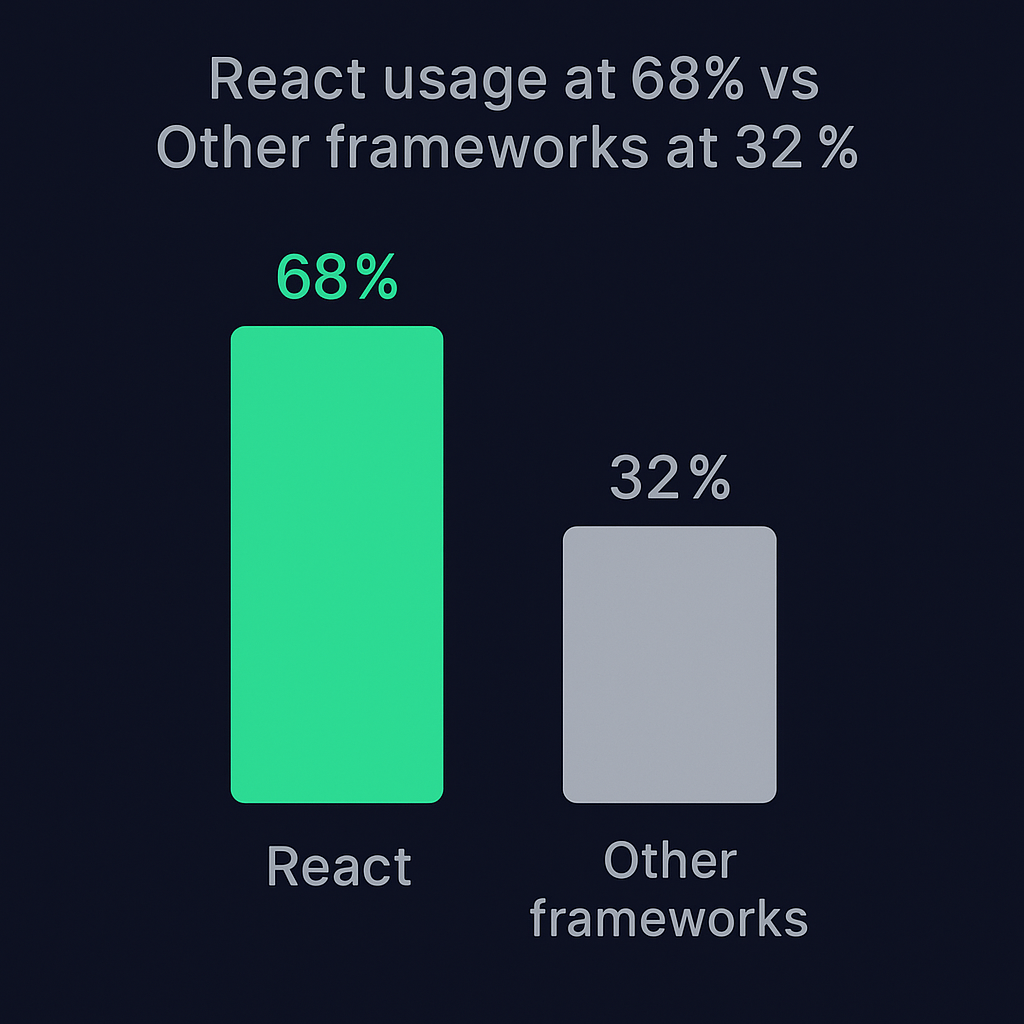
React continues to lead in front-end popularity: a recent survey shows 68% of developers work with it regularly.
Assessing Your Angular Landscape
Before any code changes, perform a thorough audit of your application’s modules, dependencies and performance bottlenecks. This will help you:
Identify high-value components to migrate first
Spot hidden coupling between services and UI
Estimate parallel maintenance overhead
Cost Modeling Different Tactics
Compare three main approaches to see which fits your budget and risk tolerance:
Approach | Description | Direct Costs | Indirect Costs | Risk |
|---|---|---|---|---|
Strangler-fig pattern | Wrap old features with React shells | Moderate: parallel infrastructure cost | Overhead maintaining dual systems | Low |
Route-by-route rewrite | Convert one view at a time | Moderate: incremental dev effort | Slower overall migration; split teams | Medium |
Greenfield rewrite | Build from scratch and swap in | High: full rewrite investment | High risk of feature gaps; dual test suites | High |
Strangler-fig pattern: wrap old features with React shells
Route-by-route rewrite: convert one view at a time
Greenfield rewrite: build from scratch and swap in
Each has direct and indirect costs:
Running two infrastructures in parallel
Maintaining dual design systems and test suites
Slower feature delivery during transition
A Gartner report notes that hidden maintenance costs can add up to 30% of your annual front-end budget.
Mapping Your Migration Path
Decide whether to migrate incrementally or all at once. An incremental approach lets you ship React features sooner, while a full rewrite can remove old dependencies in one go.
Bridging Frameworks with Coexistence Layers
To let Angular and React live side by side, you can use:
Custom elements (Web Components) wrapped around React roots
single-spa or Module Federation for lazy-loading React modules
Wrapper components that render React inside Angular
Each option has trade-offs in lifecycle management and bundle size. Plan an exit strategy to remove shims once migration is complete.
Adapting Your Technology Stack
React’s ecosystem differs from Angular’s CLI-driven build. Key steps:
Convert TypeScript decorators and metadata to idiomatic React types using TS project references
Align linting and formatting rules (ESLint, Prettier) across both stacks
Choose a framework Next.js for SSR/SSG, Vite for fast development
Porting Your Design System
If you used Angular Material or a custom library, map its tokens and components to a React alternative (MUI, Radix UI, Headless UI):
Extract and transform SCSS/CSS variables into a shared JSON theme
Run visual regression tests (e.g., with Percy or Chromatic) to catch style drift
Verify accessibility with axe-core or jest-axe in CI
Rebuilding Core Features
Migrating essential features first minimizes user impact and proves your path.
Forms Migration Blueprint
Angular Reactive Forms rely on decorators and observables. In React you can use React Hook Form or Formik with Zod for schema-driven validation:
Feature | Angular Reactive Forms | React Hook Form | Formik with Zod |
|---|---|---|---|
Setup | Uses decorators and Angular modules; verbose | Minimal boilerplate; hooks-based | Higher boilerplate; integrates schema definitions |
Validation | Built-in synchronous/asynchronous validation | Optional schemas; integrates with validation libs | Requires manual schema (Zod); declarative and type-safe |
Async Checks | First-class async validator support | Supported via custom resolver | Async checks via Zod refine/async parsing |
Performance Optimization | Optimized for large, reactive forms | Highly performant; minimal re-renders | Requires manual optimization; some re-renders |
Define a shared JSON schema for fields and rules
Implement async checks (e.g., username availability) with React Query
Compare render counts to optimize performance
Replacing RxJS with React-First Data Tools
Rather than port every observable, adopt React Query (TanStack Query) or SWR for server state and cache management:
Leverage built-in retries, caching policies and background refetch
Handle cancellation via AbortController instead of RxJS subscriptions
Migrate spin-up code path by path to reduce code churn
Managing Risks and Checking Performance
A solid risk plan covers SEO, security and runtime behavior.
For SSR/SSG, Next.js offers streaming and ISR to match Angular Universal’s SEO capabilities [^6]
Review CSP headers and sanitize any HTML inserted via `dangerouslySetInnerHTML` (use DOMPurify)
Tune React rendering: wrap expensive subtrees in `React.memo`, use `useCallback` for stable handlers and group state updates
[^6]: “Incremental Static Regeneration,” Vercel, https://vercel.com/docs/concepts/next.js/data-fetching/incremental-static-regeneration
Empowering Your Team
Your engineers will need hands-on exposure to React patterns:
Host paired code-modding sessions to update decorators and templates
Set up a “React guild” to share best practices and review ported modules
Track readiness with a checklist (component tests passing, type errors zeroed out)
The Final Cutover Checklist
Before you flip the switch:
All routes tested end-to-end in both frameworks
Feature flags in place to revert traffic if needed
Performance budgets met (bundle size, TTFB, hydration time)
Angular elements and polyfills removed
Next Stop: A Single-Stack Future
Once Angular is retired, you’ll maintain a unified codebase, cut your build times, and free up your team to experiment with React’s next advances—be it server components, concurrent features or cross-platform reuse with React Native. This migration sets the stage for faster iteration and simpler tooling in the years ahead.
:format(webp))
:format(webp))
:format(webp))