:format(webp))
:format(webp))
The Death of "If This Then That": Why AI Agents are Replacing Static Automation
You are likely familiar with the frustration of a broken Zapier workflow. One small change in a third-party API or a slightly different email format, and your entire automation chain collapses. By reading this, you will understand why traditional, rule-based tools are reaching their limit and how AI agents offer a more resilient, context-aware alternative. We will explore the shift from rigid triggers to goal-oriented reasoning, the hidden costs of LLM "token economics," and how to build a hybrid system that balances reliability with intelligence.
The Hidden Fragility of Your Automation Stack
Traditional automation tools like Zapier and n8n rely on a logic known as "If This Then That" (IFTTT). This requires you to map out every single step of a process in advance. If the input doesn't match your predefined criteria exactly, the automation fails. This creates a high "maintenance tax" for businesses that scale quickly.
As companies expand their digital workflows, they often face a "complexity wall" where the technical debt and the cost of fixing broken processes exceeds the actual time saved by the automation itself. Modern enterprises often deal with significant API churn, which is a primary disruptor when frequent updates to software interfaces break static connections and require manual reconfiguration.
Why Rule-Based Systems Break
Schema Changes: If a field name in your CRM changes from "First Name" to "Given Name," a static workflow often stops working because it lacks the semantic understanding to recognize the change.
Ambiguity: Traditional tools cannot "read" an email to determine if a customer is angry or just asking a question; they can only check for specific keywords, which often leads to missed context and poor customer experiences.
Fixed Paths: You must account for every edge case manually, which is nearly impossible for complex business operations that involve unstructured data or unpredictable human input.
Feature | Traditional Automation (IFTTT) | AI Agents |
|---|---|---|
Logic | Static / Rule-based | Goal-oriented / Reasoning |
Handling Schema Changes | Breaks immediately | Recognizes semantic meaning |
Data Type | Structured only | Structured & Unstructured |
Maintenance | High (Manual updates) | Low (Self-correcting) |
Moving from Triggers to Intent
AI agents represent a fundamental shift because they don't just follow a list of instructions; they pursue a goal. Instead of telling a system to "take the attachment from this email and upload it to Dropbox," you tell an agent to "organize all incoming invoices." The agent uses a Large Language Model (LLM) to reason through the task, identifying which files are invoices and which are junk.
As AI pioneer Andrew Ng explained in his analysis of agentic workflows , iterative processes allow AI models to self-correct and outperform even the most sophisticated static Large Language Models (LLMs) by refining their output through multiple reasoning cycles. This ability to "loop" and self-correct allows agents to handle unforeseen scenarios, such as a missing file or a corrupted attachment, that would stop a Zapier workflow in its tracks.
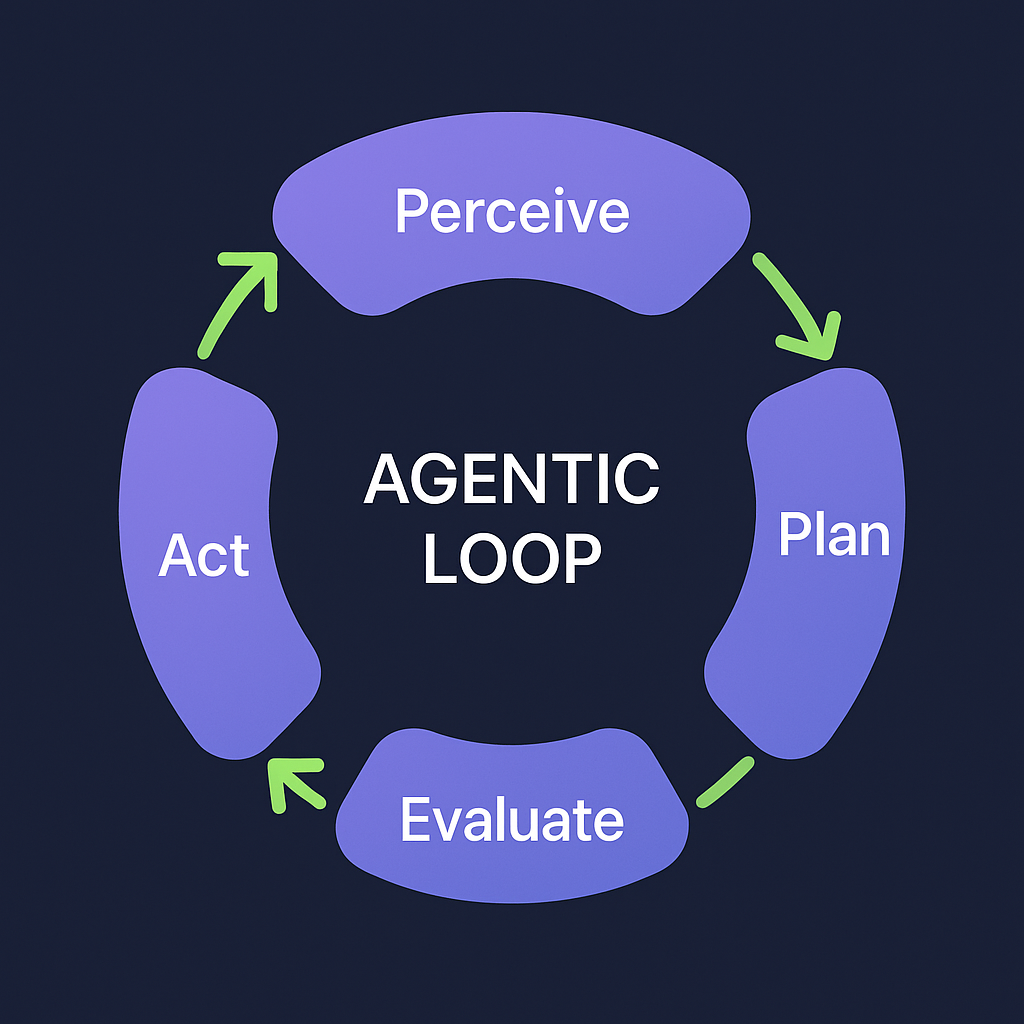
The Power of the Agentic Loop
Perceive: The agent looks at the data (an email, a spreadsheet, or a prompt) to understand the current state of the environment.
Plan: It determines the specific steps and logical sequence required to achieve the user's defined goal.
Act: It uses various tools, such as APIs, search engines, or custom code execution, to perform those steps.
Evaluate: It checks if the result matches the goal and tries again if it determines that the previous attempt failed or produced an incomplete result.
The High Price of Logic: Token Economics
While AI agents are more flexible, they introduce a new challenge: unpredictable costs. Zapier operates on a predictable "per-task" pricing model, where you know exactly what you will pay at the end of the month based on your volume. AI agents, however, consume "tokens"—the basic units of text processed by LLMs—and their usage can vary wildly depending on the complexity of the reasoning required.
Variable Reasoning Costs: A simple task might take one reasoning step today but ten steps tomorrow if the data is messy, causing your monthly operational costs to fluctuate significantly.
Long-Running Loops: If an agent gets stuck in a logic loop or fails to reach a conclusion, it could potentially consume thousands of tokens before you intervene, leading to unexpected billing spikes.
Vendor Lock-in: Moving away from traditional tools like Zapier doesn't end your reliance on outside providers; it just shifts the dependency to LLM providers. OpenAI’s token-based pricing structure illustrates that while basic automation is inexpensive, the costs of running complex reasoning tasks can scale rapidly when utilizing more advanced models for high-volume operations.
Metric | Task-Based Automation (e.g., Zapier) | Token-Based Agents (e.g., OpenAI/LangChain) |
|---|---|---|
Cost Predictability | High (Fixed per task) | Low (Variable per reasoning step) |
Scaling Efficiency | Linear | Non-linear (Complex tasks cost more) |
Failure Cost | Zero (Task doesn't run) | High (Tokens consumed during loops) |
Ideal Use Case | Repetitive data syncing | Complex decision making |
Managing the Risk of Digital Hallucinations
The biggest drawback of AI agents compared to deterministic tools like n8n is the risk of "hallucination." A Zapier workflow will never make up a customer's phone number; it either finds the data in the database or it returns an error. An AI agent, however, might confidently execute an incorrect action or invent data if it misinterprets its instructions or encounters conflicting information.
State-of-the-art Large Language Models currently exhibit a factual failure rate between 3% and 5% in specific retrieval-augmented generation tasks. This means you cannot give an agent full autonomy without building in rigorous verification loops. You require guardrails that force the agent to ask for human approval before performing high-stakes actions, such as processing a refund, deleting customer data, or sending external communications.
The Hybrid Path Forward
The most effective automation strategy isn't replacing Zapier entirely but layering AI agents on top of it. This hybrid architecture uses static tools for what they do best—reliable, repetitive data transport—and agents for "fuzzy" logic and complex decision-making.
The Processor: Use an AI agent to read a messy PDF, extract the relevant details, and turn it into structured JSON data.
The Transporter: Use a tool like n8n or Zapier to move that structured data into your database, ensuring the delivery is handled by a deterministic system.
The Auditor: Use a second, smaller and more specialized AI model to verify that the data was processed correctly before it is finalized in your system of record.
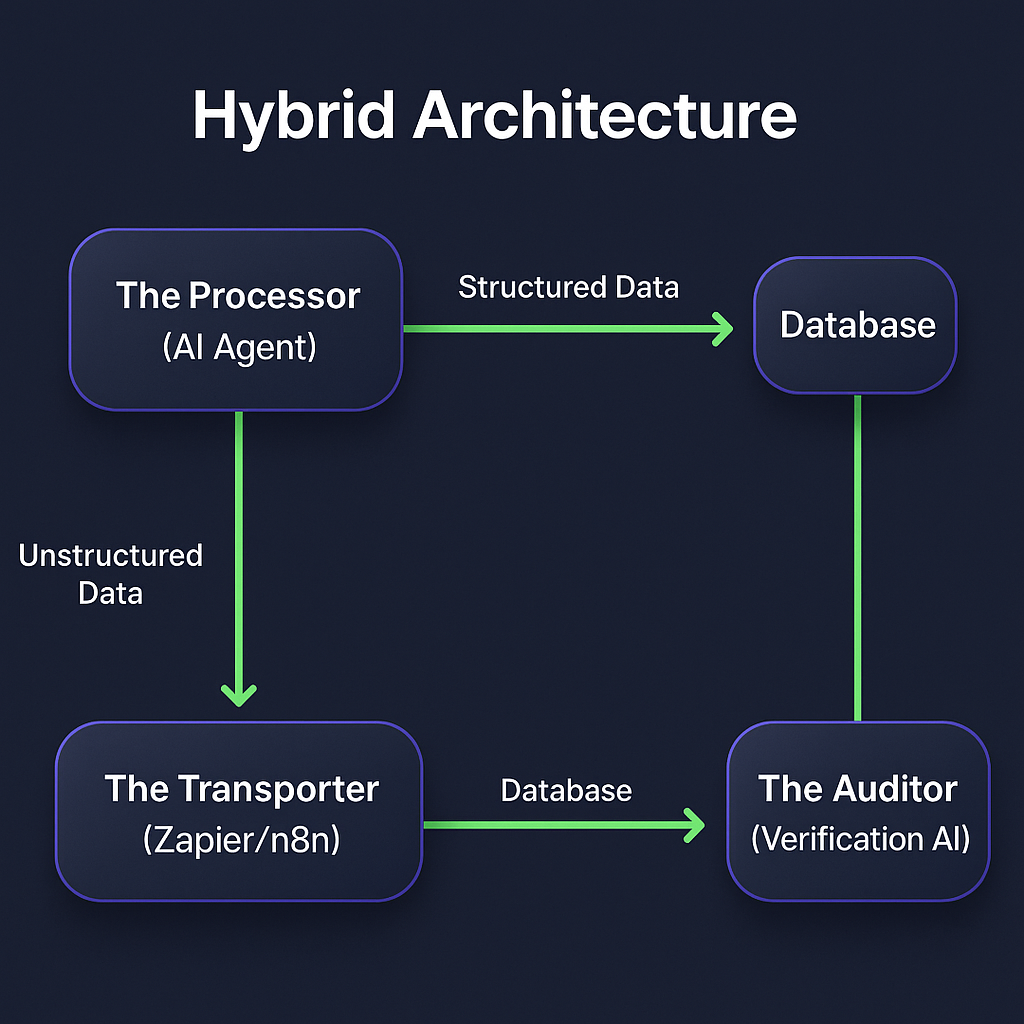
This approach reduces your total token spend and minimizes the risk of hallucinations while still benefiting from the adaptability of AI. It also helps you avoid the "debugging nightmare" of purely autonomous systems by keeping the core logic visible, auditable, and easy to troubleshoot when something goes wrong.
The Era of Autonomous Operations
We are moving toward a world where you no longer build workflows; you manage outcomes. The transition from polling-based triggers to real-time, event-driven reasoning is changing how fast businesses can respond to information. While the learning curve for implementing agents is steeper than clicking a few buttons in a no-code interface, the reward is a system that grows more resilient over time instead of more fragile. You are no longer just a builder of chains; you are a director of a digital workforce that can think, adapt, and execute on your behalf.
Want support for Custom AI Agents?
See our custom AI agent offering and reach out on demand.
Custom AI Agent Development:format(webp))
:format(webp))
:format(webp))