:format(webp))
:format(webp))
AI Agents vs. Chatbots: Why Autonomy Is the New Standard for ROI
You may think the distinction is just semantics, but choosing between a chatbot and an AI agent determines whether you are merely answering questions or actually finishing work. By reading this, you will understand how to transition from reactive scripts to proactive autonomy, helping you capture significant cost savings and operational speed that traditional tools cannot match. As businesses move toward "agentic" workflows, the focus shifts from communication to execution, fundamentally altering the value proposition of artificial intelligence in the enterprise.
From Talking to Doing: The Architecture of Autonomy
The primary difference between these technologies lies in their goal-seeking behavior. A traditional chatbot operates on rule-based logic or simple Natural Language Processing (NLP) to provide answers from a pre-defined database. It acts as a sophisticated FAQ search. In contrast, an AI agent utilizes Large Language Models (LLMs) to reason through problems, making it "agentic." According to IBM's technical breakdown of AI agents , these systems are designed to use reasoning to complete complex goals, which means an agent doesn't just provide a link to a return policy; it accesses your backend systems, verifies the purchase, and processes the refund autonomously without human intervention.
Linear Flows vs. Dynamic Reasoning
While chatbots rely on linear conversation trees, AI agents use dynamic reasoning to handle "edge cases" that fall outside standard scripts. This shift from deterministic to probabilistic outputs in Large Language Models allows the system to weigh different paths to a solution based on the specific context of your request. Instead of hitting a "dead end" and requiring a human hand-off, the agent evaluates its own next steps to reach a successful conclusion, often iterating through various strategies until the objective is met.
Feature | Traditional Chatbot | AI Agent |
|---|---|---|
Logic | Rule-based / NLP | LLM Reasoning |
Flow | Linear Conversation Trees | Dynamic Reasoning |
Goal | Answer Questions | Execute Tasks |
Flexibility | Scripted / Limited | Probabilistic / Adaptive |
The Financial Impact of True Task Execution
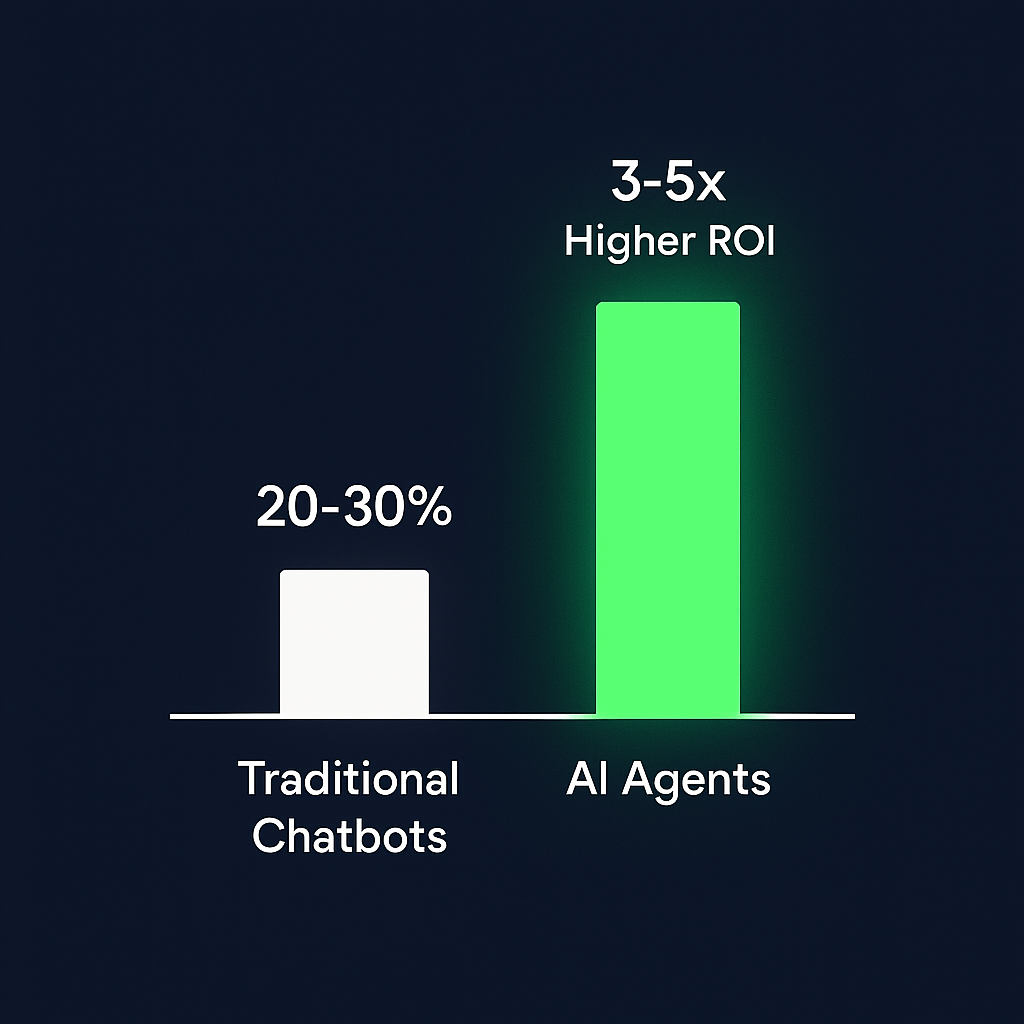
The shift to AI agents isn't just a technical upgrade; it's a financial one. While standard chatbots typically offer a 20-30% efficiency gain by resolving simple queries, full workflow automation via agents provides a much higher return. Data from McKinsey & Company suggests that generative AI could automate work activities that absorb 60 to 70 percent of employees' time , leading to a 3-5x higher ROI compared to legacy systems. Organizations utilizing autonomous agents report significant reductions in support overhead because the agent resolves the entire customer lifecycle rather than just answering a single query.
Self-Correction and Reliability
One of the most frustrating aspects of early AI was the high failure rate when users went "off-script." Modern agents solve this through reasoning loops that allow for autonomous error resolution and self-correction. When an agent encounters a system error or an ambiguous prompt, it can self-correct and try an alternative path by checking its own work against the intended goal. This reduces the number of cases escalated to your human staff, as traditional chatbots still escalate approximately 70% of non-standard interactions to live representatives, creating bottlenecks in customer service operations.
Scaling Operations with Hybrid Human-Agent Teams
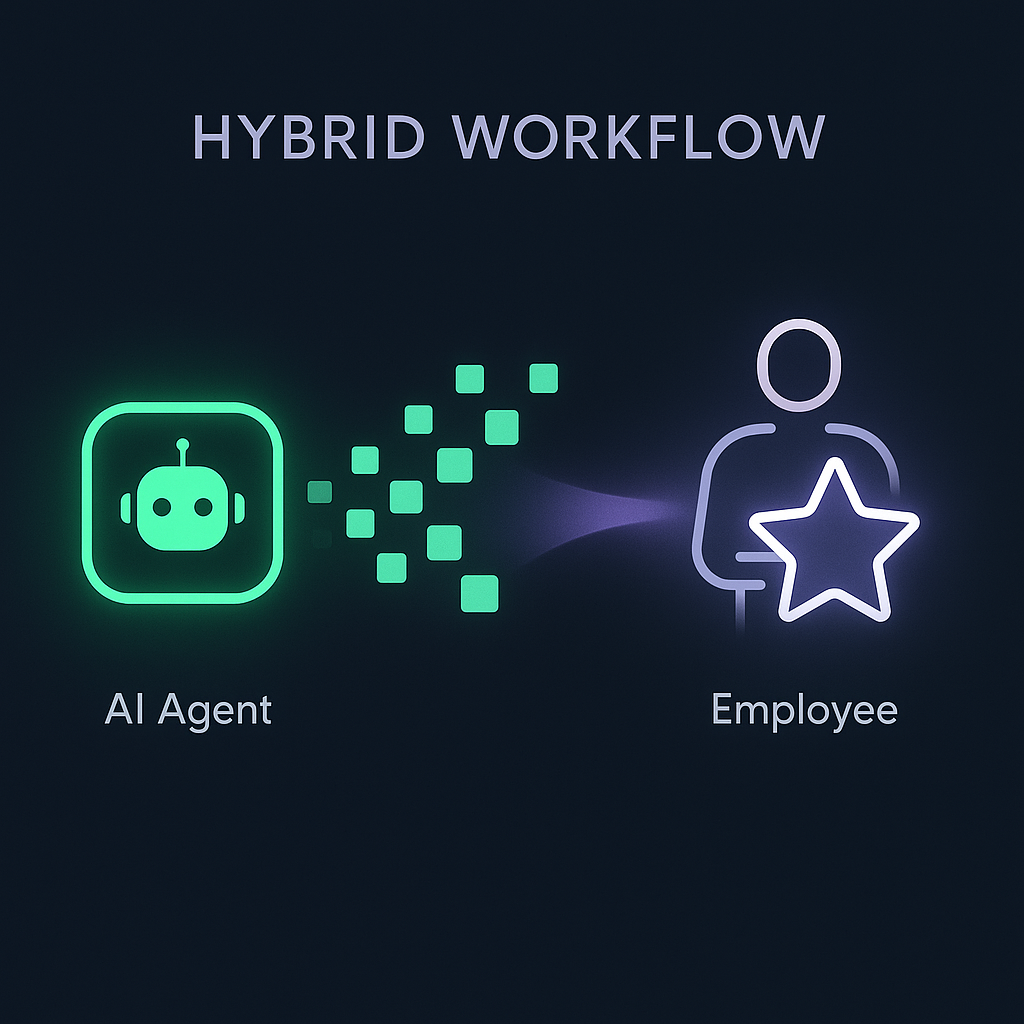
You don't have to choose between a human workforce and an AI one. The most effective business models now employ hybrid teams where agents handle 80% of routine tasks. This structure allows your sales and service representatives to focus on high-value, complex emotional interactions that require empathy and advanced negotiation. Research published by the MIT Sloan Management Review highlights that AI-human collaboration can significantly boost productivity, as the agent handles the data entry, scheduling, and information gathering before the human even joins the call, ensuring that the human employee is fully briefed and ready to provide expert-level support.
Rapid Adaptation via Reinforcement Learning
Chatbots often require manual updates to their scripts, which is slow and prone to error. AI agents utilize Reinforcement Learning from Human Feedback (RLHF). This allows them to adapt to your specific business rules much faster than static chatbots. By learning from how your best employees solve problems, the agent refines its decision-making process in real-time. This iterative learning process ensures the AI evolves with your business, maintaining alignment with corporate policies and user expectations without requiring constant manual reprogramming by IT departments.
Specialized Solutions Across the Enterprise
AI agents are moving beyond the customer service window. They are now deeply integrated into specialized business functions like the supply chain and human resources. In supply chain management, these systems use multi-tool orchestration to improve inventory management and demand forecasting by predicting delays and automatically rerouting shipments to avoid stockouts. In HR, agents have reduced employee onboarding times from several days to just a few hours with a 98% accuracy rate, handling everything from document verification to benefit enrollment in a single automated session.
Voice and Multimodal Accessibility
While chatbots are largely confined to text, new voice-enabled agents are changing the accessibility landscape. These multimodal systems can handle more complex interactions over the phone, such as real-time technical troubleshooting or complex booking requests. Some Industry reports indicate that 70% of consumers expect AI to improve their experiences, particularly when these systems offer seamless transitions between voice, text, and visual data. This is especially useful for reaching users who are not digital natives or those who require hands-free assistance in industrial or mobile environments.
Protecting Your Data in an Agentic World
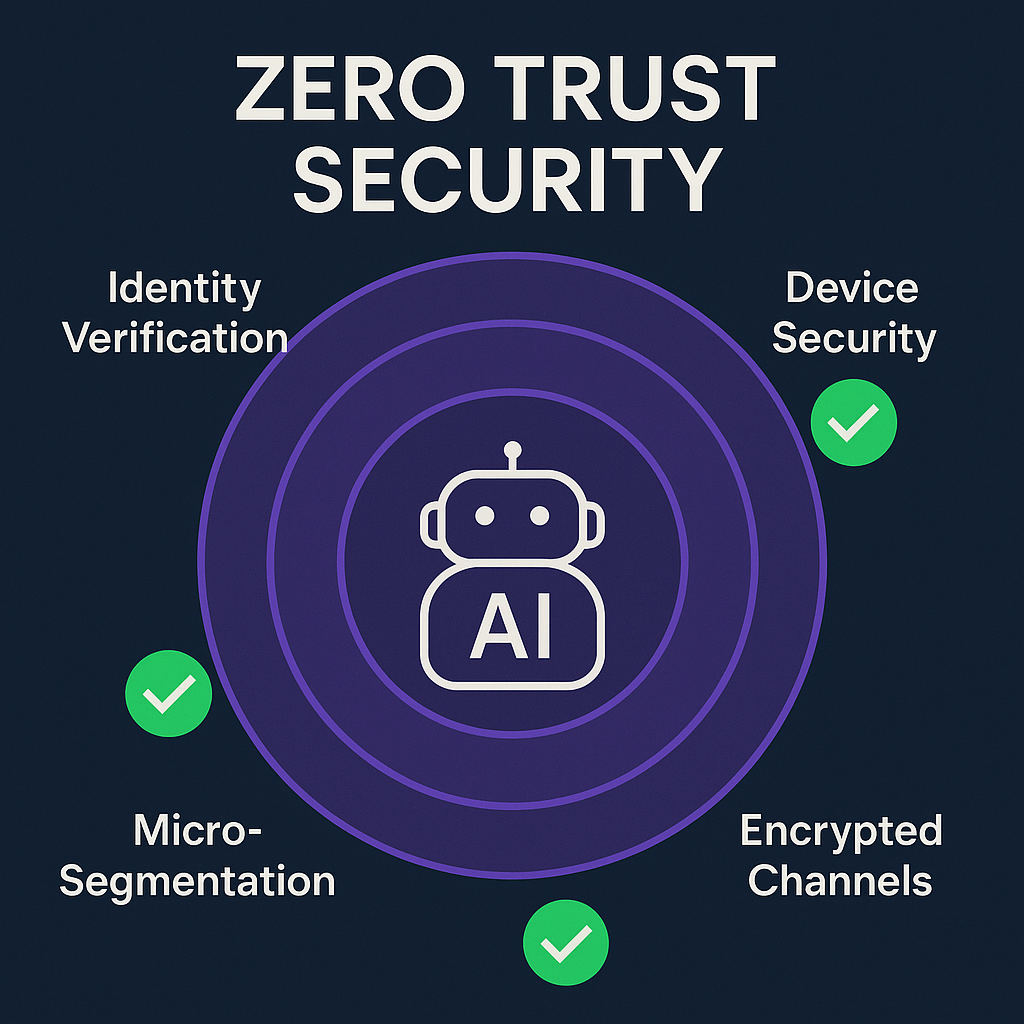
As these systems gain more access to your internal data, security becomes a priority. Unlike older chatbots that often relied on centralized databases, modern agentic frameworks can utilize specialized security protocols. By processing sensitive CRM data within [Zero Trust Architectures](https://csrc.nist.gov/glossary/term/zerotrustarchitecture) as defined by the National Institute of Standards and Technology, these systems can reduce data breach risks. This ensures that as the agent performs tasks on your behalf—such as updating financial records or accessing personal client information—your proprietary data remains shielded through strict identity verification and encrypted communication channels.
Cost Savings: Substantial reduction in support overhead and operational waste.
Accuracy: High autonomous error correction rates through reasoning loops.
Speed: Onboarding and task execution reduced from days to hours.
Privacy: Integration with zero-trust frameworks to mitigate data breach risks.
The Agentic Frontier
The transition from chatbots to AI agents represents a fundamental change in how your business interacts with technology. You are no longer just managing a communication tool; you are overseeing a digital workforce capable of independent reasoning and execution. By focusing on systems that offer high autonomy and integration, you ensure that your operations remain scalable and your team remains focused on the work that truly requires a human touch. Your ability to adopt these "agentic" workflows today will define your competitive edge tomorrow.
Want support for Custom AI Agents?
See our custom AI agent offering and reach out on demand.
Custom AI Agent Development:format(webp))
:format(webp))
:format(webp))